

How it works
The pipeline
mailbox → fetch → parse → store → assess → dashboard
                            ↑
live DNS checks- Fetch. Marcan polls one IMAP folder (every 5 minutes by default) and reads new messages. It never changes the mailbox: the folder is opened read-only and messages are read without marking them as seen. Progress is a cursor per mailbox and folder, so the same message is not imported twice, and switching to another mailbox starts that one from its first message.
- Parse. Report attachments may be XML, gzip or zip. Other attachments (office files, TLS-RPT reports) and mail without attachments are skipped silently.
- Store. Each report is stored with its records and the original XML (compressed), so a later release can process them again.
- Assess. Every verdict on the dashboard is decided on the server from the stored figures and the latest DNS check: health, the attention list, DKIM coverage, policy readiness and the DNS grade. The UI only words and colours those verdicts; the alerts and client reports use the same ones.
DNS checks run in the background for every monitored domain, about once an hour, and whenever you press Re-check DNS.
Marcan checks alignment itself
A report states what the receiver concluded, but receivers differ in how they apply DMARC. Marcan recomputes alignment for every record from the raw authentication results, using the Public Suffix List:
- A record passes DMARC when SPF or DKIM passed for a domain aligned with the
From:domain (relaxed or strict, as the domain'sadkim=/aspf=says). - SPF counts the
MAIL FROMresult. AHELOresult counts only when the record has no other SPF result (RFC 7489 §4.1).
The receiver's own verdict is kept and shown next to Marcan's (as reporter_spf_verdict and reporter_dkim_verdict in the exports).
What happened to the mail
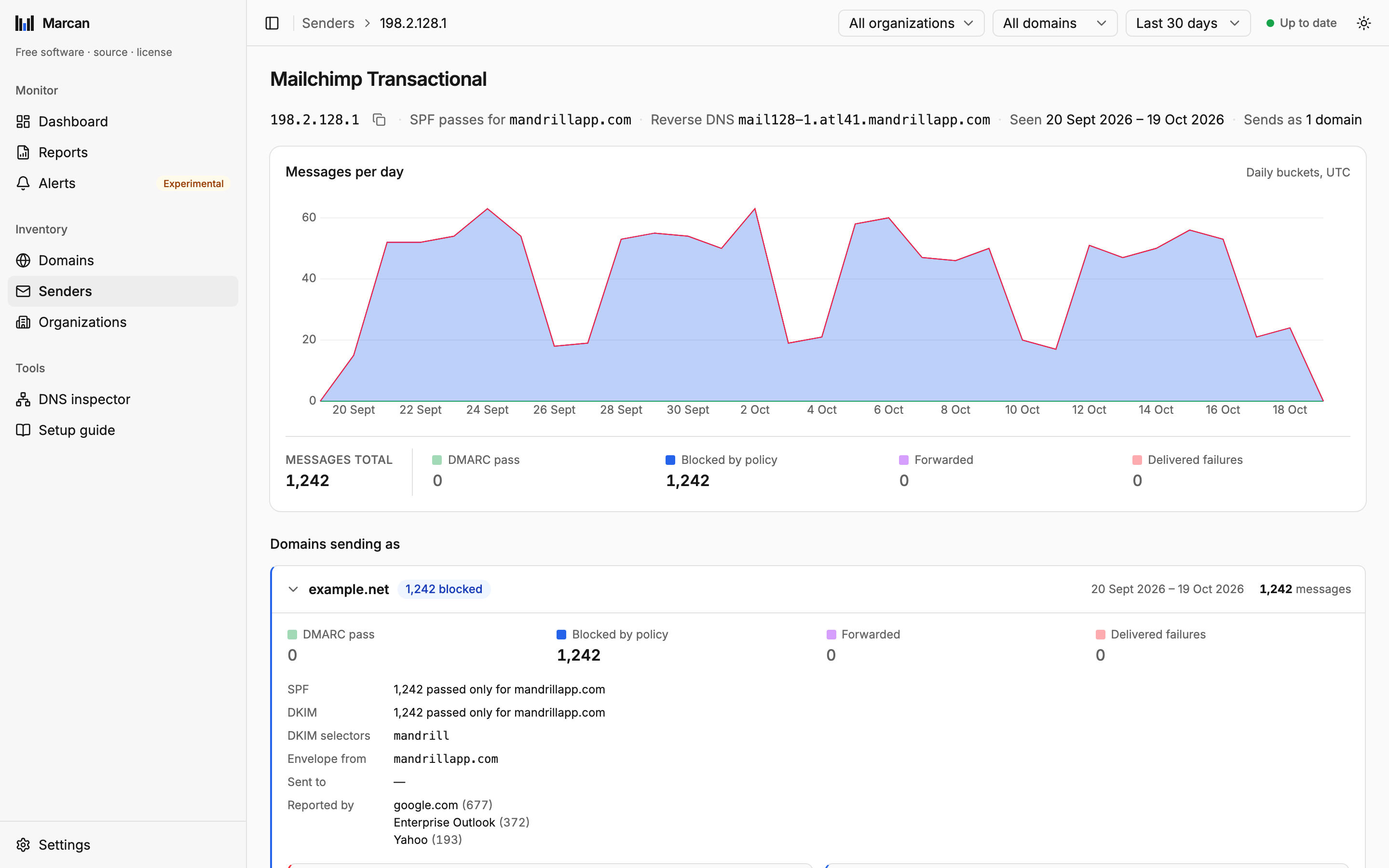
Every record has one of four outcomes, and every count, chart, filter and export uses the same four:
| Outcome | Meaning |
|---|---|
| DMARC pass | DMARC passed. |
| Blocked by policy | DMARC failed and the receiver quarantined or rejected the mail, as the policy asks. |
| Forwarded | DMARC failed in transit, but the receiver delivered it because it trusted the forwarder: the report gives a forwarded, mailing_list or trusted_forwarder reason, or notes a verified ARC chain (arc=pass). |
| Delivered failures | DMARC failed and the mail was still delivered. These are the ones to look at. |
Separating forwarded mail matters: mailing lists and forwarding break SPF, and without the split they look like spoofing.
Sender identity
Reports name senders only by IP address. Marcan names the operator behind an IP from evidence, in this order:
- forward-confirmed reverse DNS (the IP's PTR name resolves back to the IP),
- a domain whose SPF passed for that IP in your reports,
- unconfirmed reverse DNS, marked as such.
There is no built-in list of provider IP ranges. Names are captions only and never change a verdict. You can rename operators or name your own servers: see Sender names.
Thresholds
Shares of good mail (delivered compliance, DKIM coverage, a sender's pass rate) are judged by one rule:
| Share | Status |
|---|---|
| 99% or more | fine |
| 95% to 99% | worth a look |
| below 95% | a problem |
A domain whose reports stop arriving is flagged after the days of the domain warning (Settings → Mailbox, 14 by default). The DNS grade is separate and rates DNS configuration only; see DNS checks.